Shaped by the wind. Still standing.
Websites, apps and AR for Aruban businesses, built in Oranjestad. Four of them are live below.
Judge a studio by what it has shipped.
Four builds, all running today. Each one opens the real site.
-
House of Mosaic Art Villa
Art villa and gallery, Oranjestad
The guest app. Point a phone at a piece and it tells its story.
Open the app -
Pidi
Late-night delivery, from 10 PM
One order from several restaurants, one delivery fee. We built the ordering site, the kitchen screen and the driver app.
Open Pidi -
Croes Accounting
Accounting, Oranjestad
Bookkeeping, payroll and BBO filing in four languages, a client portal, and the next filing deadline counted down on the page.
croesaccounting.com -
AruSalt
Sea salt producer
Hand-harvested sea salt from Aruba. The crystal mark over the reef it comes from, with the shop behind it.
arusalt.com


A gallery that tells its own stories.
House of Mosaic Art Villa is a 1950 family home on Schotlandstraat that the artist Fernando Mansur has been covering in mosaics since 2004. The story behind each piece lived in his head, not on the wall.
Now a guest points a phone at an artwork and the piece starts talking. The camera recognises the artwork itself, so there is no QR code taped to the frame. Story Mode builds a collectible mosaic as they walk the house, and a VR gallery runs in the browser with nothing to install.
- 13artworks recognised and narrated so far.
- 5languages on the app’s screens: Papiamento, Dutch, Spanish, French and English.
- 1codebase for the web app you can open today and the iOS and Android builds.
MindAR, Three.js, Capacitor, Vite


The part customers never see.
Pidi takes late-night orders for several Aruban kitchens at once. Behind its ordering site we built the kitchen screen, where orders are accepted and marked ready, and the driver app, with the pickup list and one tap to Google Maps or Waze.
All three screens show sample orders.
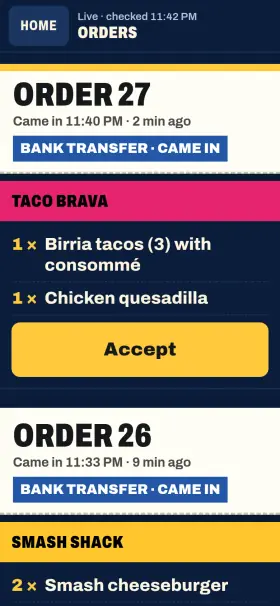
Kitchen: a new order to accept. 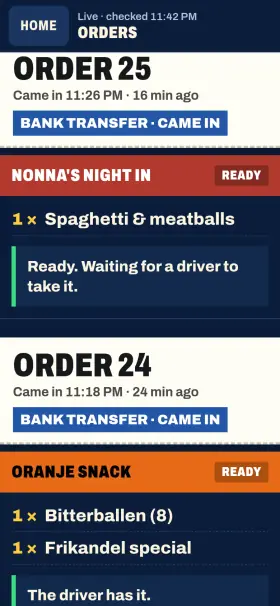
Kitchen: ready, waiting for a driver. 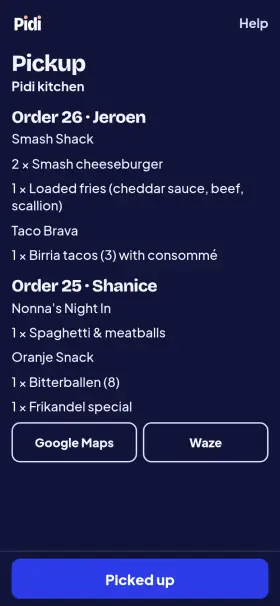
Driver: what to pick up, and where.


Four things, and nothing else.
Published, so the first conversation starts past the awkward part.
Websites
Four to six pages, mobile first, a contact form whose mail reaches your inbox, and your Google listing wired up so people can find you.
from $800one week
Mobile apps
Built once, shipped to both stores, sharing code with your website. We know what gets a build rejected by Apple and Google review before you write it.
from $4,500four to eight weeks
APIs
Your booking system, your POS and your website probably don’t talk to each other. We build the layer between them, with the authentication and rate limiting that hold up once real traffic arrives.
from $1,200two to four weeks
Augmented reality
AR that recognises real objects through a phone camera, and 3D that runs in a browser with nothing to install. We quote these one at a time, because no two are the same job.
quotedper project
Nobody pays us to find out.
Tell us what the business does
An email or a call. What you sell, and what you want somebody to be able to do on the site. That’s the whole brief. You don’t need to know what you want it to look like.
We build one before you pay
A working site on a real address, with your words and your photos. Not a mockup, and not a template with your logo dropped on it. You look at it on your own phone.
You decide
If it isn’t right, you owe nothing and we shake hands. If it is, half up front and half the day it goes live. We write the scope down first, including how many rounds of changes, so nobody is guessing by round four.
It goes on your domain
Your domain, your hosting account, your Google listing. One week for a website, longer for the bigger work, and we tell you which before you commit to anything.
Tell us what you’re building.
WhatsApp or email, two lines is enough: what the business sells, and what a customer should be able to do on the site.
Nos ta papia Papiamento, Nederlands, Español y English.